How to Build a Subscription Business on Shopify: A Complete Guide
Every Shopify merchant wants revenue that arrives whether or not they run a campaign this week and that is exactly what a subscription business delivers: predictable, recurring income that compounds instead of resetting to zero on the first of every month. Done well, subscriptions smooth cash flow, lift customer lifetime value, and make the business easier to forecast and fund. Done poorly, they become a churn machine of failed payments and cancellation emails. This guide covers how Shopify subscriptions work, which model fits your products, the apps that power recurring billing, and the retention tactics that decide whether your recurring revenue actually sticks.
 Jul 31, 202611 min read
Why Subscriptions Are Worth Building
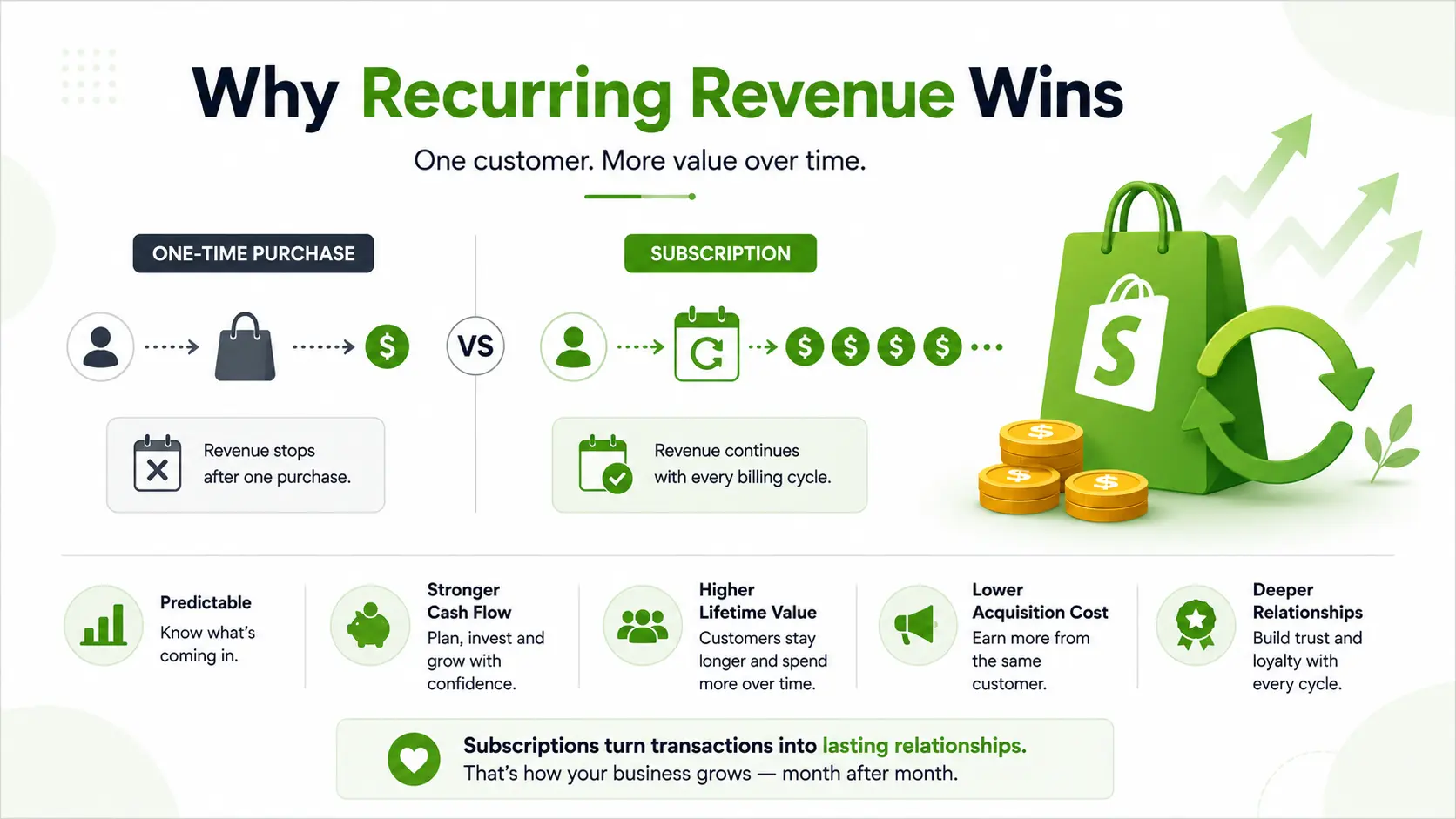
Recurring revenue is worth more than one-off revenue, rupee for rupee and dollar for dollar. It is more predictable, easier to finance, and it deepens the customer relationship with every cycle. Instead of paying to reacquire the same customer repeatedly, you earn from them again at close to zero additional acquisition cost.
The strategic case is simpler than any statistic. A one-time purchase is a transaction. A subscription is a relationship with a billing schedule attached. Everything you do afterwards a product improvement, a packaging upgrade, a loyalty gesture compounds across the whole subscriber base instead of landing on a single order.
There is a cash-flow argument too. When a meaningful share of next month's revenue is already committed, you can plan inventory, hire, and spend on marketing with far more confidence than a store starting from zero every month.
If you sell consumables, replenishable products, or anything with a loyal repeat customer base supplements, coffee, skincare, pet food offering only one-time purchases leaves money on the table. The rest of this guide is the practical playbook for fixing that.
Supplements are the clearest example, since customers reorder on a fixed cycle — we cover the full build in our guide to developing a supplement store on Shopify.
1. Choose Your Subscription Model
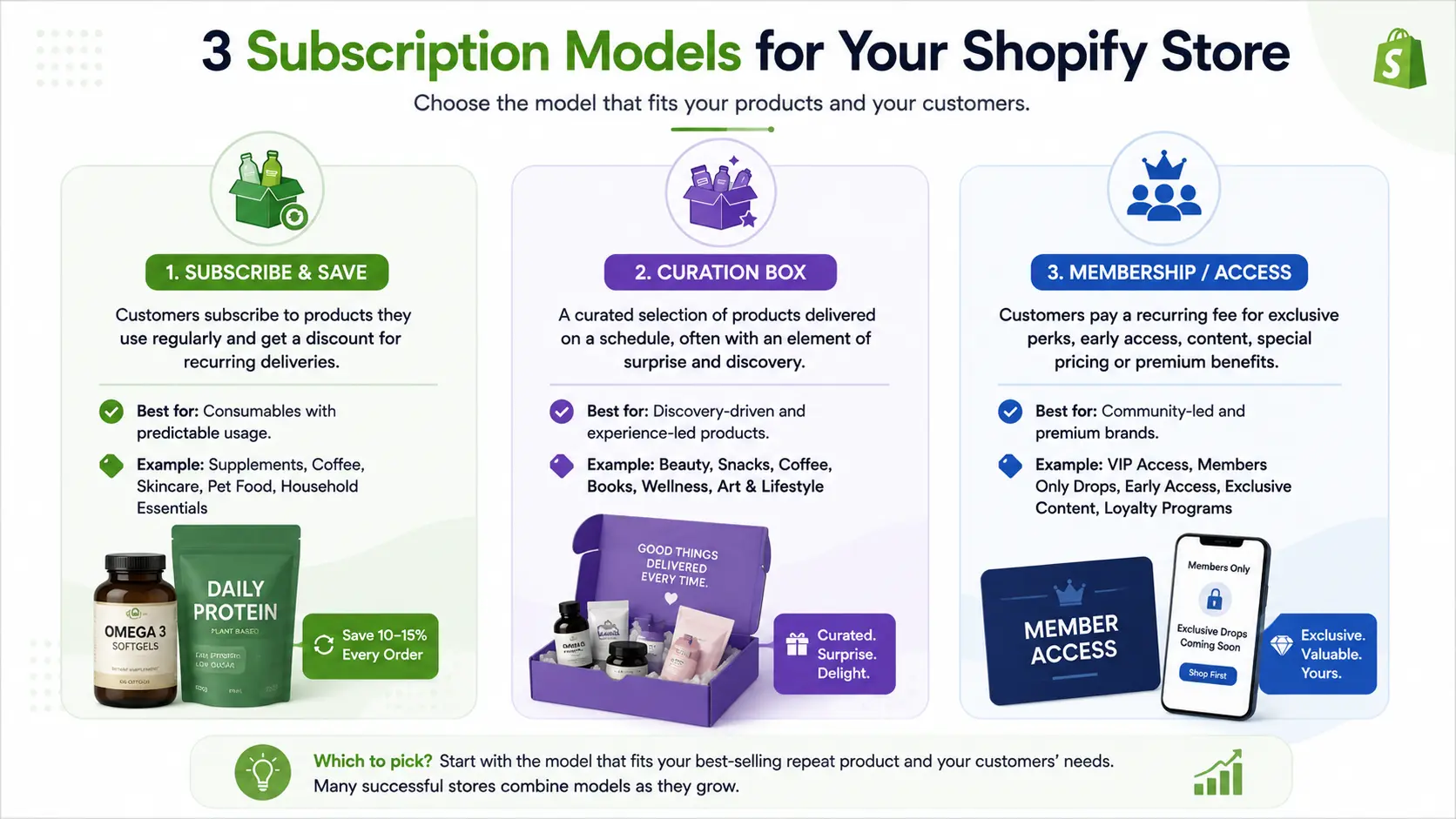
Before you touch your theme or install an app, decide which model matches your product and how customers actually behave. Three patterns cover most stores.
Subscribe and Save (Replenishment)
The Amazon-popularised model. Customers subscribe to something they already buy regularly and receive a discount commonly in the region of 10–15% in exchange for commitment. Best for consumables with a predictable consumption cycle.
This is the lowest-friction place to start, because you are not asking customers to want something new. You are asking them to automate a purchase they were going to make anyway.
Curation or Subscription Box
A curated selection delivered on a schedule, often with an element of surprise. Best for discovery-driven categories such as beauty, snacks, coffee, or books.
A Shopify subscription box carries higher expectations. Customers are paying for your taste, not just your logistics, so curation quality becomes the retention driver.
Access or Membership
Customers pay a recurring fee for perks, early access, exclusive products, or content rather than a physical shipment each cycle. Best for community-led and premium-tier brands.
Membership works when your brand already has pull. It rarely works as a first subscription experiment.
Which to pick: start with the model that fits your best-selling repeat product. Many successful stores eventually blend approaches a replenishment core with an optional membership tier layered on top but that comes after the mechanics are running smoothly, not before.
2. Pick the Right Shopify Subscription App
Here is the single most important technical fact: Shopify's native checkout does not process recurring billing on its own. Building a subscription business on Shopify requires either the free Shopify Subscriptions app or a third-party Shopify subscription app that manages the recurring charge, the subscriber portal, and failed-payment recovery.
The leading options in 2026, each with a different sweet spot:
App | Best For | Notes |
Shopify Subscriptions | Getting started at zero cost | Free, native, basic |
Recharge | Widest integration ecosystem, strong churn tooling | Market leader |
Skio | Modern subscriber portal, easiest migration from another app | Newer, polished UX |
Appstle | Mixed bundles and mix-and-match | 0% transaction fees |
Seal | Stores starting out on a tight budget | Most affordable |
Pricing varies. The native app is free, while third-party apps generally start in the $9–$25 per month range for entry tiers, some adding a small transaction fee on subscription revenue. Most offer a free trial, so you can validate the setup before paying anything. Check current pricing directly on each app's listing before deciding.
A practical note on choosing. The free native app is genuinely the right starting point for many stores. Migrating between subscription apps later is painful you are moving live payment tokens and active billing schedules, not just records. So the real question is not "which app is best" but "which app will still fit when we have ten times the subscribers." If you expect complex bundles or heavy automation, pick for that from the start.
For Shopify Plus brands running at scale, pairing a premium subscription app with Plus unlocks checkout customisation and automation that lower plans cannot match.
3. Set Up Billing and Payments
A common point of confusion: there is no separate "subscription payment settings" tab in Shopify. Subscription apps use the payment gateway already configured in your main Shopify settings to process both the first order and every recurring charge after it. Configure your gateway correctly once, and the app handles the rest.
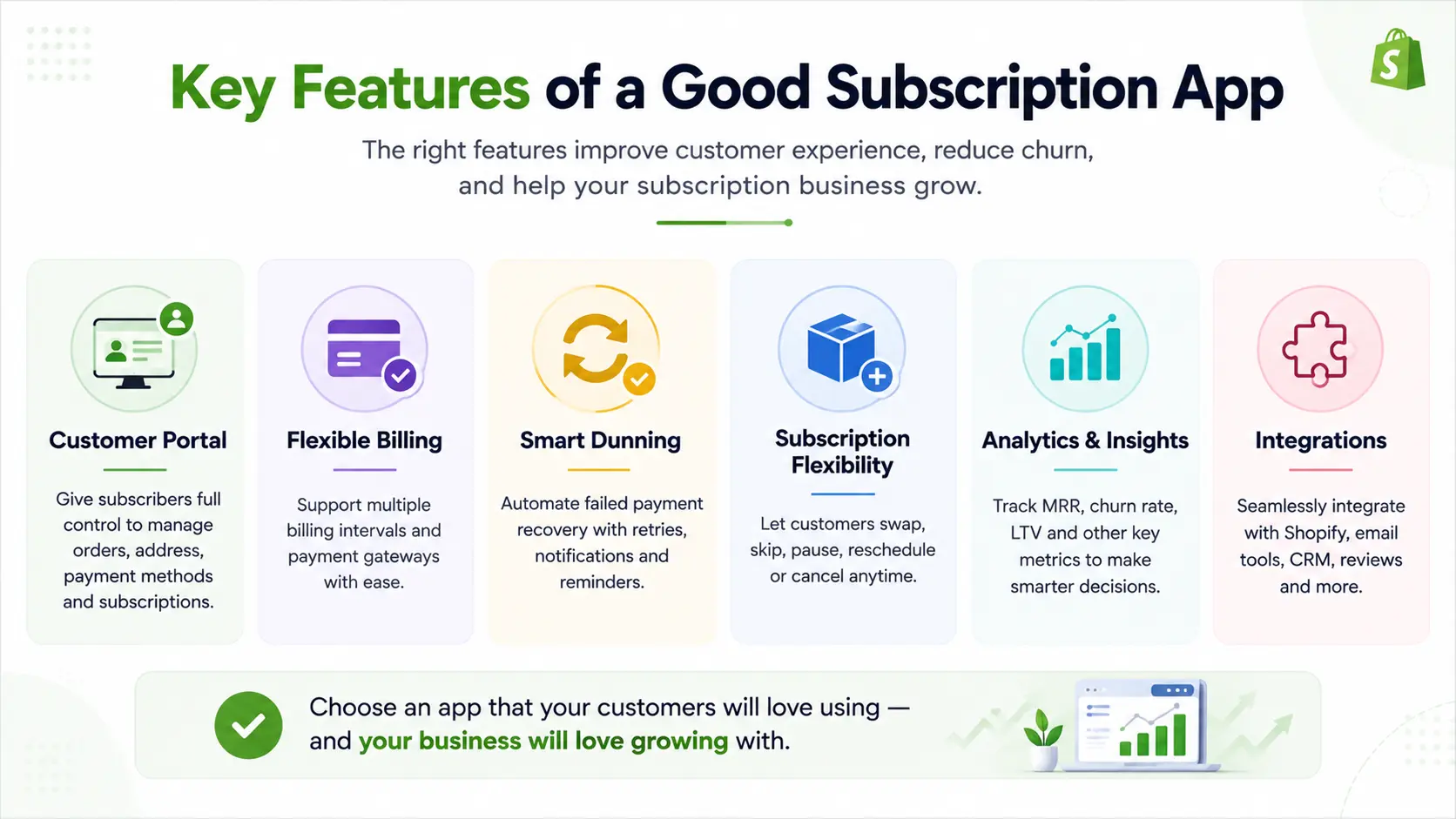
What matters most here is dunning management the automated retrying of failed cards. Cards expire, get replaced, and decline for dozens of reasons that have nothing to do with intent. Without automated retries and card-update prompts, you silently lose subscribers who never decided to leave.
For most programmes, failed payments cost more revenue than deliberate cancellations do. Every serious subscription app includes dunning, and it is one of the strongest arguments against building recurring billing from scratch.
Two things worth checking before launch:
• Retry schedule — how many attempts, spread across how many days.
• Card-update flow — whether the customer gets a link to update their card themselves, and how clearly it is worded.
4. Design the Subscriber Experience
The difference between a growing programme and a churn machine often comes down to one thing: the customer portal. Subscribers must be able to pause, skip, swap, or reschedule their own orders without emailing support.
When self-service is easy, people pause instead of cancelling. Paused subscribers come back. Cancelled ones usually do not.
• Pause and skip. Let subscribers take a break rather than quit entirely. This single feature recovers a substantial amount of lifetime value, and it costs nothing beyond configuration.
• Swap and mix. Allow product changes so a subscription flexes with the customer's needs instead of going stale. A subscriber bored of one flavour should be able to switch, not forced to choose between boredom and cancellation.
• Clear renewal reminders. A pre-billing email a few days before renewal reduces disputes and chargebacks and builds trust. Merchants sometimes resist this, fearing it prompts cancellations. In practice it prevents the far more damaging outcome a surprise charge, a chargeback, and a customer who now distrusts the brand.
5. Fight Churn From Day One
Acquiring subscribers is only half the job. Keeping them is where the revenue actually compounds, and churn needs attention from launch rather than after the base starts shrinking.
Beyond a good portal and solid dunning, the highest-leverage tactics are:
• A surprise free gift - inside a subscriber order one of the most effective retention levers available, and cheap relative to its impact.
• Loyalty milestones — recognise the third, sixth, and twelfth cycle with something small.
• Proactive outreach - to at-risk subscribers before they cancel, triggered by signals such as a skipped cycle or a failed payment.
Small consistent gestures beat large win-back discounts offered after someone has already left. A win-back discount also teaches customers that leaving gets rewarded, which is not a habit you want built into your base.
6. Measure What Matters
You cannot improve what you do not track. Four metrics tell you whether the programme is healthy.
• Subscription revenue as a share of total revenue. This is your headline number. Watch the direction it moves in rather than chasing a benchmark what matters is that the share grows quarter on quarter.
• Active subscriber count. If new signups exceed churn, the base grows. If not, it shrinks regardless of how good the month looked. Watch this weekly through the first year.
• Lifetime value against subscriber acquisition cost. LTV needs to comfortably exceed what you spend to acquire each subscriber, with enough margin to absorb a bad quarter. Calculate both from your own data rather than industry averages your product margin and churn profile are what decide this.
• Churn rate. The percentage leaving each cycle. Every point you shave off compounds across the entire base, which is why churn work outperforms acquisition work once you have a few hundred subscribers.
A useful discipline: review these four numbers on the same day each week. Subscription businesses fail slowly, and slow failure is only visible in a trend line.
Where Metizsoft Fits In
Installing a subscription app is easy. Building a subscription programme that actually retains subscribers is not.
Choosing the right model, configuring the gateway properly, designing a portal customers can use without help, customising checkout on Shopify Plus, and wiring Shopify Flow automations for churn alerts this is where most merchants want a hand. And when an off-the-shelf app cannot express your exact billing or bundling logic, that is where custom Shopify app development comes in.
As an official Shopify Partner with our own published Shopify apps, Metizsoft helps merchants choose the right subscription stack, integrate it cleanly, and build custom functionality when the standard tools do not fit.
And for merchants who want ongoing engineering support rather than a one-off build, METON our AI-augmented Shopify maintenance service works with subscription commerce brands specifically, delivering native Liquid code from $499/month.
If you would rather launch recurring revenue correctly the first time than untangle a leaky setup a year later, we can help.
Book a free 30-minute consultation — metizsoft.com/contact
Frequently Asked Questions
Can Shopify handle subscriptions natively?
Shopify's checkout does not process recurring billing on its own. You need either the free Shopify Subscriptions app or a third-party Shopify subscription app such as Recharge, Skio, or Appstle to manage recurring charges, the subscriber portal, and failed-payment recovery.
How much does it cost to add subscriptions to Shopify?
The native Shopify Subscriptions app is free. Third-party apps generally start in the $9–$25 per month range for entry tiers, with some adding a small transaction fee on subscription revenue. Factor in your base Shopify plan as well. Most apps offer a free trial before you commit, and current pricing is always worth checking on the app listing directly.
Which products work best as subscriptions?
Consumables and replenishable products are the strongest fit supplements, coffee, skincare, pet food. Curated boxes and membership access also work well. The test is simple: does the customer buy it on a predictable cycle?
How do I stop subscribers from churning?
Give subscribers a self-service portal to pause, skip, and swap orders. Use automated dunning to recover failed payments. Send pre-billing reminders. Reward loyalty with occasional surprise gifts. Making it easy to pause rather than cancel recovers significant lifetime value.
How do I know if my subscription programme is healthy?
Track four things: subscription revenue as a share of total revenue, active subscriber count, lifetime value against acquisition cost, and churn rate. Direction matters more than any benchmark. If the subscriber base is growing and churn is falling quarter on quarter, the programme is working. Review the numbers weekly during the first year.
Can I switch subscription apps later without losing subscribers?
It is possible but genuinely difficult, because you are migrating live payment tokens and active billing schedules rather than just records. Some apps, notably Skio, have built migration tooling for exactly this. Even so, choosing an app that fits where you expect to be in two years is far easier than moving later.
Related Reading
Want to go further with your store? Read Best Shopify Conversion Apps: Turn More Visitors into Customers, 20 Best Shopify Apps to Boost Sales, and Agentic AI in Shopify: How Autonomous Agents Are Reshaping eCommerce Operations.
About Metizsoft
Metizsoft Solutions is an eCommerce and software development company founded in 2012 and an official Shopify Partner since 2013. With 3,000+ projects delivered and offices in India, the USA, the UK, and Singapore, we serve clients across 25+ countries. We specialise in Shopify development, Shopify Plus, Shopify app development, and subscription commerce.
Related Services
Shopify Development | Shopify Plus Development | Shopify App Development | Hire Shopify Developer

Leave a Reply