Agentic AI in Shopify: How Autonomous Agents Are Reshaping eCommerce Operations
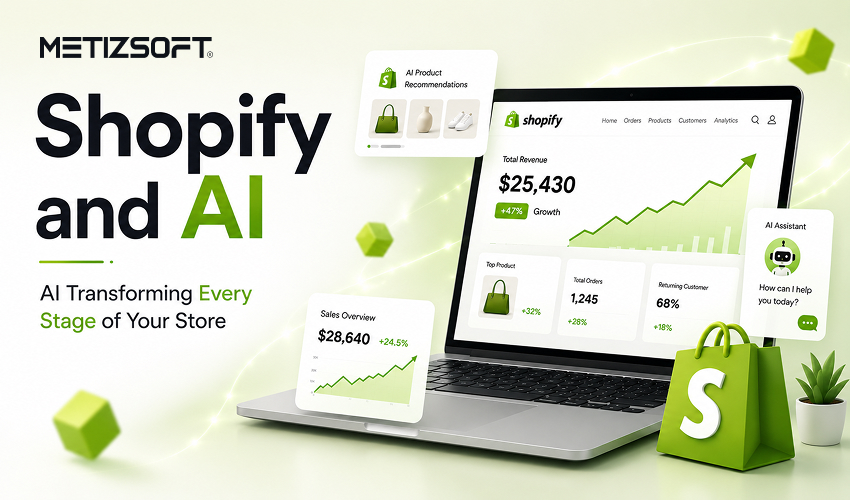
Running a Shopify store means handling dozens of repetitive operational tasks every day writing product descriptions, answering customer queries, recovering abandoned carts, and managing inventory. Agentic AI changes this by introducing autonomous agents that handle these tasks end-to-end, without merchants managing each step. Unlike basic AI apps that assist, agentic AI in Shopify acts understanding goals, making decisions, and completing entire workflows on its own. This guide walks through where autonomous agents add value across Shopify operations, the real use cases, how they connect to your store, and what a deployment involves.
Introduction The Operational Reality of Running a Shopify Store
Anyone who has run a Shopify store knows the truth: the platform makes it easy to launch, but running a store day-to-day is a different story. Behind every successful store is a constant stream of operational work writing and updating product descriptions, responding to customer enquiries, chasing abandoned carts, monitoring stock levels, and making sense of analytics.
For most merchants, this work scales with the business. More products mean more descriptions. More customers mean more support tickets. More traffic means more carts to recover. At some point, the operational load becomes the ceiling on growth there are only so many hours in the day.
This is the problem agentic AI solves. Unlike the AI features bundled into apps, which assist a merchant who is doing the work, agentic AI introduces autonomous agents that take the work off the merchant's plate entirely. They do not just suggest a product description; they write, publish, and optimise it. They do not just flag an abandoned cart; they run the entire recovery sequence and improve it over time.
This guide examines how agentic AI is reshaping Shopify operations, function by function, and what it means for merchants who want to grow without drowning in operational work.
What Agentic AI Means for Shopify Merchants
It is worth being precise about what makes agentic AI different from the AI tools most Shopify merchants have already used. The distinction is the difference between a tool and an operator.
A traditional Shopify AI app assists you. You ask it to draft a product description, and it offers a suggestion that you then review, edit, and publish. You are still doing the work; the app is simply speeding up one step of it. An agentic AI agent, by contrast, acts on your behalf. Give it the goal of listing a new product, and it writes the description, optimises it for search, assigns the right collections, and publishes it then monitors how it performs and refines it.
The same pattern holds across every function. Where a traditional app sends a single templated cart-recovery email, an agentic agent runs the full recovery strategy across channels and learns what works. Where an app gives you answer templates for support, an agentic agent resolves the entire customer conversation. The shift is from single-task assistance to end-to-end workflow ownership and that shift is what frees a merchant to spend less time operating their store and more time growing it.
Autonomous Product Listing and SEO
Product listings are foundational to a Shopify store's success, and one of the most time-consuming tasks to maintain at scale. An agentic AI listing agent handles the entire process on its own generating SEO-optimised titles and descriptions from product data or images, writing meta descriptions and alt text for search visibility, assigning products to the correct collections and tags, and updating everything when details or pricing change.
What makes the agentic approach different is that it does not stop at creation. The agent monitors how each listing performs in search and refines it over time to improve rankings. For stores with large catalogues, this is transformative: what once required days of manual copywriting, or an expensive content team, now happens autonomously with consistent quality and built-in SEO. As we covered in our guide on how NLP automates orders in Shopify, natural language processing is the engine that makes this level of automation possible.
AI-Driven Personalization and Product Discovery
Shoppers who find relevant products quickly tend to buy more. Agentic AI personalises the discovery experience for every visitor, adapting in real time to what each shopper is looking at and looking for.
The agent analyses browsing behaviour as it happens to understand intent, then serves personalised recommendations tailored to each visitor. It powers intelligent search that understands natural-language queries rather than just keywords, and it adapts homepage and collection displays to individual preferences. Crucially, it keeps learning from conversion data, so the recommendations improve continuously.
This level of one-to-one personalization was once available only to large retailers with dedicated data teams. Agentic AI brings it within reach of any Shopify merchant, turning a generic storefront into a tailored experience that lifts both conversion rate and average order value.
Autonomous Cart Recovery and Conversion
Cart abandonment is one of the most expensive problems in eCommerce the majority of carts are abandoned before checkout. An agentic AI recovery agent runs the entire recovery process autonomously, going far beyond a single reminder email.
When a cart is abandoned, the agent identifies the likely reason and runs a multi-channel recovery sequence across email, SMS, and on-site messaging personalising both the message and the timing for each shopper. Importantly, it offers incentives only when they are actually needed, protecting margins rather than reflexively discounting. And it continuously tests what recovers the most carts, improving its own performance over time.
We explored this specific application in depth in our guide on converting lost Shopify sales with AI. The advantage of the agentic approach is autonomy: the agent does not just send a templated email, it owns the full recovery strategy and refines it, recovering revenue that would otherwise be lost.
AI Customer Support Agents
Customer support is essential but resource-intensive. An agentic AI support agent handles the majority of customer interactions on its own, around the clock.
It answers product, order, and policy questions through natural conversation, retrieves real-time order status and tracking information, and processes returns, exchanges, and refunds within the rules you define. It handles enquiries across multiple languages and channels, and when a case genuinely needs a human a complex complaint, a sensitive situation it escalates with the full context already gathered, so your team can step in without starting from scratch.
By resolving routine enquiries autonomously, the agent brings response times close to zero and lets human staff focus on the conversations that genuinely need a personal touch. For a growing store, this means scaling support without scaling headcount.
Inventory and Demand Management
Stockouts lose sales; overstock ties up capital. Agentic AI optimises inventory by forecasting demand and managing stock proactively, rather than reactively.
The agent forecasts demand at the product level using historical and seasonal data, flags products at risk of running out before they actually do, and identifies slow-moving inventory that should be promoted or cleared. It recommends reorder quantities and timing based on real demand patterns, and adjusts its forecasts in real time as sales trends shift.
Accurate demand forecasting has a direct impact on profitability fewer lost sales from stockouts, less capital trapped in excess inventory, and healthier cash flow. Agentic AI makes this kind of forecasting accessible without a dedicated operations team.
Marketing and Performance Insights
Marketing and analytics quietly consume a great deal of merchant time. Agentic AI automates campaign creation and turns raw store data into clear, actionable insight.
The agent generates marketing copy for email, social, and ad campaigns, segments customers and personalises campaigns to each group, and runs A/B tests on its own, applying the variations that win. Just as valuable, it monitors store performance and surfaces what is working and what is not and rather than simply reporting that conversion dropped, it identifies why and acts on it.
Instead of spending hours interpreting dashboards, merchants receive clear recommendations and autonomous action. The analytics stop being a report you have to decode and become a system that improves the store on your behalf.
How Agentic AI Connects to Your Shopify Store
A common concern among merchants is whether adopting agentic AI means replacing their existing setup. It does not. Agentic AI integrates with Shopify through the platform's established APIs, working alongside your store rather than replacing it.
In practice, the agents connect through the Shopify Admin API for products, orders, inventory, and customer data, and through the Storefront API for personalised shopping experiences. They work with the apps and tools you already use, and connect to third-party systems your email platform, CRM, or ERP for joined-up workflows.
The agents operate as an intelligent layer on top of Shopify, reading data, making decisions, and taking action through the platform's own APIs. This keeps implementation low-risk and means you do not have to abandon the tools and workflows you already rely on. For stores on Shopify Plus, the possibilities extend further still, as we discussed in our guide on the Universal Commerce Protocol for Shopify Plus.
What a Deployment Involves
The investment for agentic AI in Shopify depends on how much you choose to automate and how complex the integration is. The most sensible way to think about it is in stages rather than as one large project.
Most merchants begin with a single, high-value agent typically customer support or cart recovery which can usually be deployed within a couple of months. This is the lowest-risk way to start, because it proves the value on a clearly measurable function before you expand. A focused listing-and-SEO agent for a large catalogue, or a combined cart-recovery-and-personalization setup aimed at conversion, sits a step up in both scope and timeline.
From there, stores that want to automate broadly move toward a multi-agent setup where several agents handle different functions and share data effectively running much of the store's day-to-day operation autonomously. This is naturally a larger undertaking, but by the time a merchant reaches it, they have already seen the return from the earlier stages.
Ongoing costs come down to AI usage and maintenance, but the return is usually clear: autonomous agents handle the work of several staff members while operating continuously, and the revenue they recover or generate typically covers the investment within months. The right starting point depends entirely on where your store's operational load is heaviest which is exactly the kind of assessment worth doing before committing to a build.
Frequently Asked Questions
Do I need to replace my existing Shopify apps to use agentic AI?
No. Agentic AI integrates with Shopify through its APIs and works alongside your existing apps and tools. The agents operate as an intelligent layer on top of your store, reading data and taking action through Shopify's own systems. You keep the tools and workflows you already rely on.
How is agentic AI different from the AI features already in my Shopify apps?
Most Shopify AI apps assist you while you do the work suggesting a description, drafting an email. Agentic AI does the work for you. An agentic support agent resolves the entire customer conversation; an agentic cart-recovery agent runs the full recovery sequence and improves it over time. The difference is autonomy agents act, they do not just assist.
Is agentic AI only for large Shopify stores?
No. While large stores benefit enormously, the per-task economics of agentic AI often make it even more valuable for small and mid-sized merchants who do not have staff to handle operational work. A single autonomous agent can give a small team the operational capacity of a much larger one.
Can agentic AI work with Shopify Plus?
Yes. Shopify Plus offers deeper API access and customisation, which expands what agentic AI can do — from advanced personalization to complex multi-store operations. Plus merchants can build more sophisticated autonomous workflows than standard Shopify allows.
How long does it take to deploy agentic AI on a Shopify store?
A focused, single-function agent such as customer support can typically be deployed within a couple of months. A full multi-agent system covering several store functions takes longer. Most merchants start with one high-value use case and expand from there once they see results.
Will agentic AI maintain my brand voice and quality?
Yes, when set up correctly. Agents are configured with your brand guidelines, tone, and rules before deployment. For content like product descriptions and customer responses, you can keep human review in the loop until you are confident in the output. The agent learns your standards and applies them consistently.
Related Reading
For a closer look at specific Shopify AI applications, read our guides on converting lost Shopify sales with AI and how NLP automates orders in Shopify. To understand the broader shift toward autonomous AI systems, see From Copilot to Autonomous Agent: How Agentic AI Is Taking Over the Software Development Lifecycle. And for an example of agentic AI in another operational setting, read Agentic AI in Logistics.
Ready to Bring Agentic AI to Your Shopify Store?
Metizsoft has been a Shopify Partner since 2013 and brings 14+ years of experience in both eCommerce and AI development. Our team builds agentic AI agents tailored to Shopify stores from autonomous customer support and cart recovery to product listing automation and demand forecasting integrated cleanly with your existing store.
Whether you want to automate a single function or build a fully autonomous Shopify operation, we can assess what will deliver the most value for your store and outline a clear implementation roadmap.
Book a free 30-minute consultation - metizsoft.com/contact
About Metizsoft
Metizsoft Solutions is a leading AI, ML, and eCommerce development company founded in 2012, and an official Shopify Partner since 2013. With 400+ engineering specialists, 3,000+ projects delivered, and offices in India, the USA, the UK, and Singapore, we serve clients in 25+ countries. We specialise in Shopify Development, Shopify Plus, Agentic AI, AI Agent Development, and AI-powered eCommerce solutions for merchants and brands worldwide.
Related reading: Shopify Development | AI Agent Development | Shopify Cart Recovery AI | Shopify Plus Development — metizsoft.com/shopify-experts
Leave a Reply