What is the Difference Between Neural Networks and Deep Learning?
If you want to know what makes deep learning different from neural networks, you’re not the only one. Neural networks, like many parts of AI, are inspired by how our brain works, while deep learning is a specialized neural network with many layers that can extract complex patterns from large datasets. This blog explains the […]
 Oct 27, 20256 min read
If you want to know what makes deep learning different from neural networks, you’re not the only one. Neural networks, like many parts of AI, are inspired by how our brain works, while deep learning is a specialized neural network with many layers that can extract complex patterns from large datasets. This blog explains the differences between neural Networks and Deep Learning in a simple way, making it great for anyone who wants to adapt these powerful AI tools and understand how they influence today’s technology.
Introduction
Artificial intelligence has become part of our lives and affects many aspects of everyday life, from using our phones and smartwatches to running businesses. Two important concepts in this field are neural networks and deep learning. Although they sound the same, they have different roles. You can think of neural networks, such as the basic building blocks and deep learning, as more advanced versions that can handle more challenging tasks. Learning about both helps you understand how AI makes smart choices and runs modern technology.
What is a Neural Network?
Neural networks are a type of data model inspired by the way our brains work. It consists of multiple layers of “neurons” (nodes) that share information. A network usually consists of three main parts:
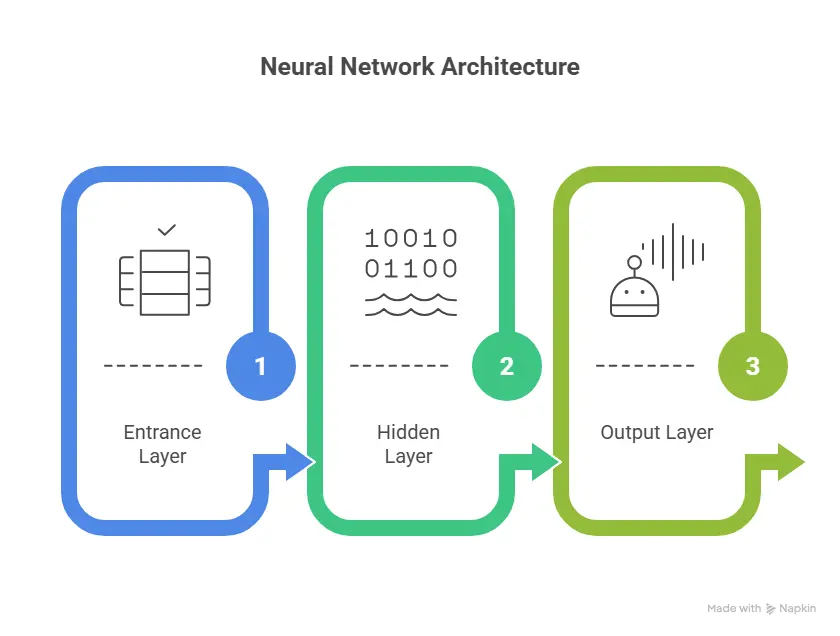
Entrance layer: This section receives the first data, such as an image or sound.
Hidden Layer(s): These layers work on the data by doing simple math. In a basic neural network, there are usually one or two of these layers.
Output Layer: This layer gives the final outcome, such as recognizing an object or predicting a number.
The network learns by changing “weights” on the connections between neurons while it is being trained, which helps it make better decisions. Neural networks are great for doing easy tasks like recognizing handwritten numbers or spotting simple patterns.
What is Deep Learning?
Deep learning is a type of neural network with many more layers. Instead of just one or two hidden layers, deep learning models can have many. These extra layers help the system learn complicated features step by step.
For instance, in image recognition, the first layers might spot edges, the middle layers would notice shapes, and the later layers would recognize things like faces or cars.
This added depth makes deep learning very good at tricky tasks like recognizing speech, understanding language, and driving self-driving cars. However, it requires a large amount of data and powerful computers, often using graphics processing units or cloud services such as AWS.
Neural Network vs. Deep Learning Structure and Architecture
The basic difference in structure comes from the number of layers and their complexity. Neural networks are usually “shallow,” with just one or two hidden layers, while deep learning models are considered “deep” because they have many layers.
Neural Network Architectures
Feedforward Neural Networks: Information travels in a single direction, starting from the input and going to the output.
Recurrent Neural Networks (RNNs): Made to manage sequences, like language or sounds, and include feedback loops.
Symmetrically Connected Networks: Have equal connections between their neurons, which is a bit different from recurrent networks.
Deep Learning Architectures
Convolutional Neural Networks (CNNs): Designed specifically for processing images and videos.
Recursive Neural Networks: Use the same weights repeatedly on structured data.
Unsupervised Pre-Trained Networks: Such as autoencoders, which learn from information without needing specific labels.
Deep Learning and Neural Networks Comparison Table
Aspect | Neural Network | Deep Learning |
Architecture | Few layers, Simpler | Many layers, complicated with layered learning |
Application | Simple pattern finding, smaller data sets | Image recognition, language processing, and large data sets |
Performance | Does well with small amounts of data | Excels well with large and strong processing power |
Training Time | Quicker, use fewer computing resources | Takes longer, needs a graphics card, and a strong computer |
Feature Extraction | Manual or minimal learning of features | Learns features in its own right at different levels |
Challenges | Limited by its setup, has trouble with complicated data | Needs a lot of data and computing power, risks of memorizing instead of learning |
How Do Neural Networks and Deep Learning Function Inside?
Neural Network Components
Neurons: These are like small math units that take in information and produce results.
Connections and Weights: Connections link the neurons together, and weights decide how much each input affects the output.
Forward Propagation: This is when data flows through the network to create predictions.
Backward Propagation: Here, the network changes weights based on errors in the predictions for better results.
Learning Rate: This calculates how much the weights are adjusted during the training process.
Deep Learning Model Components
Multiple Layers: In this layer, the model learns about features in steps or levels.
GPUs: It uses stronger graphics processing units to perform calculations faster.
Large Memory and Storage: The model requires a lot of memory and storage space to process large amounts of data.
Complex Infrastructure: It may include advanced computing systems and cloud services like AWS Sagemaker to help it work better.
Get Going with Neural Networks and Deep Learning
Understanding what sets neural networks apart from deep learning allows you to see how artificial intelligence (AI) has advanced. Neural networks provided the foundation, but deep learning, with its many layers, has enabled the notable developments we encounter in daily technology use. Whether you are really interested in AI or want to create your own neural network model, adapting these basic concepts sets you up for lasting success. Metizsoft, as a leading deep learning development agency, will back up your vision and help you leverage these technologies to craft innovation that matters.
Common FAQs on Neural Networks and Deep Learning
Are neural networks and deep learning the same?
No, deep learning is a part of neural networks that uses many hidden layers to help it understand complicated patterns.
Which one should I use for my project?
If your project is simple and does not require much data, regular neural networks should work. If you’re dealing with more complex data and tasks, deep learning would be better.
Do I need huge datasets for deep learning?
Yes, having big datasets makes deep learning work better, but you can use transfer learning to need less data.
How does deep learning improve AI performance?
It makes feature extraction automatic and learns different levels of information, which helps achieve better accuracy.
Where can I learn more and get started?
Although you can learn it from various tutorials and online courses, the best learning happens when you collaborate with experienced professionals who can teach you with live demos and practical lessons.


Leave a Reply