12 AI Use Cases Transforming Retail Banking in 2026
Retail banking is being reshaped by artificial intelligence not as a single feature, but across nearly every part of how banks operate and serve customers. From AI fraud detection banking and credit scoring to autonomous customer support and compliance automation, AI is helping banks cut costs, reduce risk, and deliver faster, more personalised service. This guide walks through twelve of the most impactful AI use cases in retail banking today what each one does, why it matters, and the value it delivers so you can see where AI fits in a modern bank.
 Jul 6, 202610 min read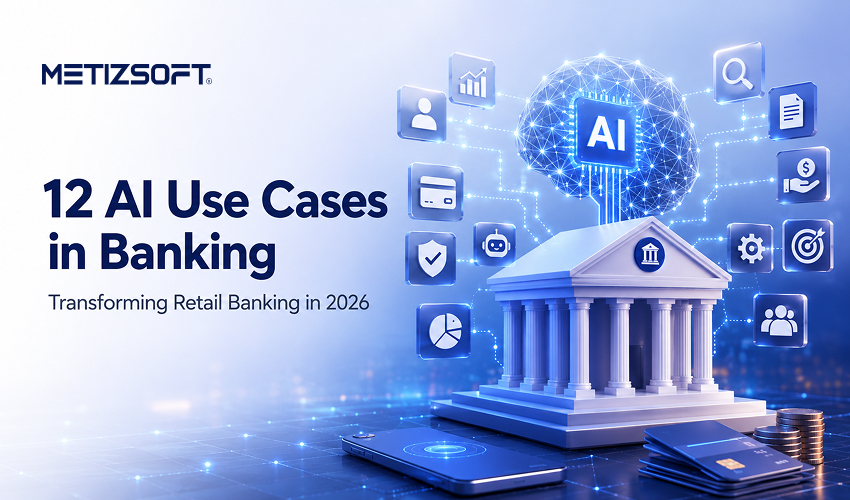
Introduction Why AI Is Now Central to Retail Banking
Retail banking has always run on two things: trust and efficiency. Customers need to trust that their money is safe and their bank understands them, and banks need to operate efficiently enough to serve millions of customers profitably. For years, these two goals were in tension better service meant more staff and higher costs.
Artificial Intelligence (AI) is resolving that tension. It allows banks to deliver faster, safer, more personalised service while simultaneously reducing operational cost and risk. This is why AI has moved from a experimental side-project to a central pillar of retail banking strategy.
The shift is broad. AI technologies now touch fraud prevention, lending decisions, customer service, compliance, and personalisation often working quietly in the background of interactions customers never think twice about. As we explored in our guide on agentic AI in banking, the most advanced banks are moving beyond simple automation toward autonomous systems that act on their own within defined rules.
Below are twelve of the most impactful AI use cases reshaping retail banking today.
1. Real-Time Fraud Detection
Fraud is one of the costliest problems in banking, and speed is everything a fraudulent transaction caught in seconds is prevented; one caught hours later is a loss. AI fraud detection analyses every transaction in real time, spotting the subtle patterns and anomalies that signal potential fraud far more accurately than rule-based systems.
Because AI learns from each new case, it adapts to evolving fraud tactics rather than relying on fixed rules that criminals learn to bypass. It flags genuinely suspicious activity instantly while letting legitimate transactions through without friction protecting both the bank's money and the customer's experience.
2. AI-Powered Credit Scoring
Traditional credit scoring relies on a narrow set of factors and often excludes people with limited credit history. AI-powered credit scoring assesses creditworthiness using a far richer picture transaction patterns, behaviour, historical data, and dozens of alternative signals to predict default risk more accurately.
This means better lending decisions for the bank and fairer access to credit for customers who traditional models would wrongly reject. It also happens in seconds rather than days, enabling instant lending decisions. We covered the predictive side of this in our guide on deep learning for predictive analytics.
3. Autonomous Customer Support Agents
Customer service is expensive and hard to scale, yet customers expect instant, around-the-clock help. Autonomous AI support agents handle the majority of customer enquiries on their own checking balances, explaining transactions, resolving common issues, and answering product questions through natural conversation.
Unlike simple chatbots, these agents actually resolve issues end-to-end, escalating to human staff only when a case genuinely needs a person and doing so with full context attached. The result is instant service for customers and dramatically lower support costs for the bank.
Conversational banking assistants live or die on the quality of the NLP development underneath — intent handling and entity extraction do more for accuracy than model size alone.
4. Loan Underwriting Automation
Loan underwriting has traditionally been slow, manual, and inconsistent. AI underwriting automates the assessment of loan applications analysing financials, risk factors, and supporting documents to produce fast, consistent decisions.
This cuts approval times from days to minutes, removes human inconsistency from decisions, and frees underwriters to focus on complex cases that genuinely need judgment. For customers, it means faster answers; for banks, it means higher throughput and better risk control.
5. Anti-Money-Laundering (AML) Monitoring
AML compliance is a massive, costly obligation for every bank and traditional rule-based systems generate enormous volumes of false alerts that teams must wade through manually. AI-driven AML monitoring detects genuinely suspicious patterns far more precisely, dramatically reducing false positives.
By learning what real suspicious activity looks like, AI focuses compliance teams on the cases that actually matter, speeds up investigations, and strengthens the bank's regulatory position all while reducing the manual burden that makes AML so expensive.
6. Personalised Banking and Recommendations
Customers increasingly expect their bank to understand them the way their favourite apps do. AI-enabled personalisation analyses customers behavior to offer genuinely relevant insights, products, and guidance the right savings suggestion, the right product, at the right moment.
This moves banking from generic, one-size-fits-all service to a tailored experience that helps customers manage their money better. For the bank, relevant personalisation deepens relationships, improves retention, and increases the value of each customer.
7. Predictive Analytics for Customer Behaviour
Predictive analytics lets banks anticipate what customers will do next which customers are likely to leave, who might need a particular product, and where financial difficulty may be building. This foresight turns banking from reactive to proactive.
By identifying customers at risk of churning early, a bank can intervene while it still can. By spotting signs of financial stress, it can offer help before a problem becomes a default. Prediction, applied well, benefits both the bank and the customer.
8. Intelligent Document Processing
Banks handle enormous volumes of documents applications, statements, identity papers, contracts. Processing these manually is slow and error-prone. Intelligent document processing uses AI to read, understand, and extract information from documents automatically.
This eliminates hours of manual data entry, reduces errors, and accelerates every process that depends on paperwork from onboarding to loan applications. Staff are freed from tedious document handling to focus on higher-value work.
9. KYC and Onboarding Automation
Know Your Customer (KYC) checks are essential but are a common point where new customers abandon the process out of frustration. AI-powered KYC automation verifies identity documents, runs required checks, and completes onboarding in a fraction of the traditional time.
This means new customers can open accounts in minutes rather than days, dramatically reducing drop-off, while the bank maintains full compliance. Faster onboarding directly translates to more customers successfully acquired.
10. Conversational AI and Virtual Assistants
Conversational AI gives customers a natural, intuitive way to bank asking questions and completing tasks through simple conversation, by text or increasingly by voice. Modern AI-powered chatbots and virtual assistants understand intent and context, not just fixed commands.
A customer can ask "how much did I spend on groceries last month?" and get an instant, accurate answer. As we discussed in our guide on voice AI agents, these assistants are becoming a primary interface for everyday banking convenient for customers and efficient for banks.
11. Risk Management and Early Warning
Beyond individual transactions, banks must manage risk across their entire portfolio. AI risk management continuously monitors for emerging risks in lending, markets, and operations surfacing early warnings long before problems become serious.
By analysing vast amounts of data in real time, AI spots the patterns that precede trouble and alerts the bank while there is still time to act. This shifts risk management from periodic review to continuous, proactive protection.
12. Cross-Sell and Upsell Intelligence
Knowing which product to offer which customer and when has always been part art, part guesswork. AI cross-sell intelligence removes the guesswork by predicting which products a customer genuinely needs based on their behaviour and life stage.
This means offers that feel helpful rather than pushy, presented at the right moment through the right channel. Done well, it increases revenue per customer while actually improving the customer relationship because the recommendations are genuinely relevant.
How Banks Can Get Started With AI
The breadth of these use cases can make the adoption of AI feel overwhelming, but the most successful banks do not try to do everything at once. They start with a single, high-value use case often fraud detection or customer support where the impact is immediate and measurable.
From there, they expand into adjacent areas, building on the data infrastructure and confidence established by the first project. The key is to begin where the return is clearest, prove the value, and scale from a position of demonstrated success when leveraging AI for the long term. Working with an experienced AI development partner who understands both the technology and the strict compliance demands of banking makes this journey faster and lower-risk.
Frequently Asked Questions
Is AI in banking secure and compliant?
It must be, and with proper implementation, it is. AI systems in banking are built within secure, compliant infrastructure with encryption, access controls, and full audit trails. Compliance and security are the foundation of any banking AI project which is why working with developers experienced in financial regulation is essential.
Will AI replace bank employees?
No. AI handles repetitive, high-volume tasks fraud checks, document processing, routine enquiries so staff can focus on complex cases, relationships, and judgment. The goal is to make employees more effective, not to replace the human expertise that banking depends on.
How long does it take to implement AI in a bank?
A focused use case, such as a fraud detection or customer support system, can be deployed in a few months. Broader, multi-use-case transformations take longer. Most banks start with one high-value application and expand from there once value is proven.
Do we need to replace our core banking systems to use AI?
No. AI tools integrate with existing banking systems through APIs, working as an intelligent layer on top of your current infrastructure. Your core systems continue to operate; the AI enhances them rather than replacing them.
Which AI use case should a bank start with?
Start where the impact is clearest and most measurable often fraud detection (immediate risk reduction) or customer support automation (immediate cost and experience gains). Proving value on a focused use case builds the foundation for broader adoption.
How much does it cost to implement AI in retail banking?
Cost depends heavily on the use case, scale, and integration complexity. A focused deployment is a far smaller investment than a full transformation. The right approach is to assess a specific use case, quantify its expected return, and start there the ROI on well-chosen banking AI is typically clear.
Related Reading
For a deeper look at autonomous AI in finance, read our guides on agentic AI in banking and agentic AI in embedded finance. To understand the predictive technology behind credit scoring and risk, see deep learning for predictive analytics. And for how conversational AI is reshaping customer interaction, read voice AI agents.
Ready to Bring AI to Your Bank?
Metizsoft brings 14+ years of experience in AI, machine learning, and financial software development. Our team builds AI solutions for banks and fintech companies from fraud detection and credit scoring to conversational agents and compliance automation, and other AI applications designed with the security and regulatory rigour that banking demands.
Whether you want to deploy a single high-value use case or plan a broader AI transformation, we can assess what is feasible and compliant for your institution and outline a clear, practical roadmap.
Book a free 30-minute consultation — metizsoft.com/contact
About Metizsoft
Metizsoft Solutions is a leading AI, ML, and software development company founded in 2012. With 400+ engineering specialists, 3,000+ projects delivered, and offices in India, the USA, the UK, and Singapore, we serve clients in 25+ countries. We specialise in Agentic AI, AI Development, Machine Learning, Predictive AI, NLP, and financial software solutions — building secure, compliant intelligent systems for banks, fintech, and finance businesses worldwide.
Related reading: Agentic AI in Banking | AI Development | Embedded Finance | Banking & Finance Solutions — metizsoft.com
Leave a Reply