From Copilot to Autonomous Agent: How Agentic AI Is Taking Over the Software Development Lifecycle
Introduction The Shift From Copilot to Autonomous Agent In 2022 , GitHub Copilot felt like magic. A developer would start typing a function and the AI would complete it.…
 May 28, 202613 min read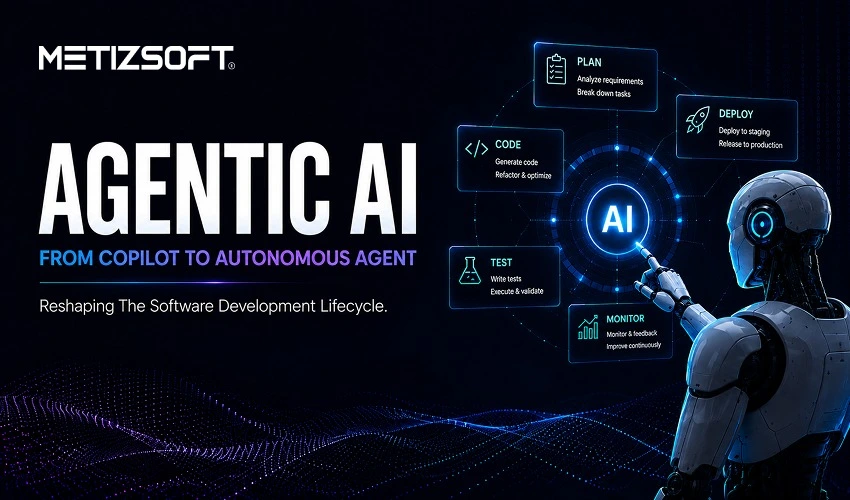
Introduction — The Shift From Copilot to Autonomous Agent
In 2022, GitHub Copilot felt like magic. A developer would start typing a function and the AI would complete it. Productivity went up. Bugs went down. Teams were happy.
By 2024, that same capability started feeling ordinary — because the benchmark had shifted. Engineering teams were no longer asking AI to complete their code. They were asking AI to own entire workflows: write a feature from a ticket description, test it autonomously, catch the regressions, open a pull request, and flag the edge cases for human review. The developer's role in that process? Review and approve, not build from scratch.
This is the difference between AI copilots and agentic AI systems in software engineering. Copilots assist. Agentic AI acts. And for engineering teams still only using copilot-style tools, the productivity gap between them and agentic-first teams is growing fast.
At Metizsoft, we have been integrating agentic AI into software development workflows for enterprise and SaaS clients across logistics, fintech, and eCommerce. This guide shares exactly what that looks like in practice — the tools, the use cases, the results, and the honest trade-offs.
Copilot vs Agentic AI — What Is the Actual Difference?
The distinction matters because it determines how much your team's productivity can actually improve. A copilot is reactive — it responds to what the developer does. An agentic AI system is proactive — it pursues a goal autonomously, using tools, making decisions, and completing multi-step workflows without waiting for human prompts at each step.
Capability | AI Copilot (GitHub Copilot, Cursor) | Agentic AI (Devin, Claude Code, AutoDev) |
How it works | Responds to developer input | Pursues goals autonomously |
Task scope | Single function or file | Full features and workflows |
Tool usage | None — suggests only | Runs terminal, browser, tests, APIs |
Decision making | Waits for developer | Decides next steps independently |
PR creation | Writes code only | Opens PR with description and tests |
Bug fixing | Suggests fix when asked | Detects and fixes autonomously |
Testing | Does not run tests | Writes and executes full test suites |
The practical implication: a copilot saves a developer 20-30% of typing time. An agentic AI system can reduce the time spent on routine engineering tasks by 40-70%, freeing engineers to focus on architecture, product decisions, and the genuinely complex problems that still require human judgment.
Use Case 1: Autonomous Code Writing and Generation
The most visible application of agentic AI in software engineering is autonomous code generation — but not in the copilot sense of completing a function. Agentic code generation means taking a natural language specification — a ticket, a PRD, a Slack message — and producing a complete, working implementation including edge case handling, error states, and documentation.
What the agent does
Reads the ticket or specification in natural language
Breaks the requirement into subtasks and plans an implementation approach
Writes code across multiple files maintaining consistency with the existing codebase style
Handles imports, dependencies, and configuration automatically
Writes inline documentation and function-level comments
Flags ambiguous requirements for human clarification before proceeding
Real-world result
Cognition AI's Devin — the first fully autonomous AI software engineer — demonstrated the ability to complete 13.86% of SWE-bench tasks end-to-end without human help. That benchmark covers real GitHub issues from production codebases. For routine feature development, internal benchmarks from engineering teams using agentic code generation show 3-5x faster delivery on well-specified tickets versus traditional development.
Use Case 2: AI-Powered Code Review and Bug Detection
Code review is one of the most time-consuming activities in any engineering team's workflow. Senior engineers spend 3-6 hours per week on reviews — time that could be directed at architecture, mentoring, and product work. Agentic AI code review systems handle the first pass autonomously, escalating only the decisions that require genuine human judgment.
What the agent does
Scans every pull request for logic errors, security vulnerabilities, and performance issues
Checks code style consistency against the team's established patterns
Identifies missing test coverage for new code paths
Detects common security issues — SQL injection, XSS, insecure dependencies, hardcoded credentials
Leaves specific, actionable comments with suggested fixes rather than generic warnings
Learns from reviewer feedback over time, reducing false positives as it adapts to team preferences
GitHub's internal data shows that AI-assisted code review catches 30% more defects than human-only review at the PR stage, primarily because agentic systems do not experience fatigue, distraction, or the social pressure that sometimes causes human reviewers to approve questionable code.
Use Case 3: Autonomous Testing and Quality Assurance
Testing is where agentic AI delivers some of its most measurable ROI in software engineering. Writing tests is valuable but tedious — it is exactly the kind of high-volume, well-structured task that agentic systems handle best. Autonomous AI testing agents can generate, execute, and maintain an entire test suite with minimal human input.
What the agent does
Analyzes new code and automatically generates unit tests for every function and edge case
Writes integration tests that cover the interactions between new code and existing systems
Runs the full test suite after every commit and reports failures with root cause analysis
Detects flaky tests and either fixes them or flags them for human review
Maintains test coverage above a defined threshold automatically, adding tests when new code reduces coverage
Generates regression test suites specifically targeting areas of the codebase most likely to break based on the changes made
Coverage benchmark
Engineering teams using agentic AI testing consistently achieve 85-95% test coverage — compared to the industry average of 40-60% for teams relying on manual test writing. More importantly, the time-to-test drops from days to hours, removing one of the most common bottlenecks in continuous delivery pipelines.
Use Case 4: AI-Driven Deployment and DevOps Automation
Deployment pipelines are complex, error-prone, and — when something goes wrong — extremely expensive. A failed production deployment at a mid-size SaaS company costs an average of $5,000-$50,000 per hour in lost revenue and engineering time. Agentic AI DevOps systems reduce deployment failure rates by monitoring every stage of the pipeline and taking autonomous corrective action when anomalies are detected.
What the agent does
Monitors CI/CD pipelines in real time and detects failures before they reach production
Analyzes build logs to identify root causes of failures and suggests or applies fixes autonomously
Manages environment configuration and catches configuration drift between staging and production
Triggers automatic rollbacks when post-deployment metrics — error rate, latency, throughput — fall outside defined thresholds
Optimizes infrastructure costs by scaling resources based on actual usage patterns rather than fixed allocations
Generates deployment reports with impact analysis, performance comparisons, and recommended next steps
Companies running agentic DevOps automation report 60-80% reductions in deployment-related incidents and 40-50% faster mean time to recovery when incidents do occur — because the AI agent is already diagnosing and acting within seconds of detection.
Use Case 5: Self-Healing Code and Autonomous Maintenance
Every production system accumulates technical debt, deprecated dependencies, and code that was written for a context that no longer exists. Maintaining this code is unglamorous, time-consuming, and often deprioritized until it causes a critical failure. Agentic AI maintenance systems handle this layer of the codebase autonomously — continuously improving code quality without consuming engineering sprint capacity.
What the agent does
Monitors dependency vulnerability feeds and automatically creates PRs to update affected packages
Detects and refactors code duplication, overly complex functions, and anti-patterns against the team's defined standards
Updates deprecated API calls when third-party APIs release breaking changes
Identifies performance bottlenecks from production profiling data and proposes targeted optimizations
Detects memory leaks and resource inefficiencies in long-running services and generates targeted fixes
Maintains up-to-date documentation by automatically updating README files, API docs, and inline comments when code changes
The compounding effect of autonomous maintenance is significant. Teams that deploy self-healing AI agents report spending 70% less time on unplanned maintenance work within twelve months — time that is reallocated to new feature development and architectural improvements.
Real Tools Engineering Teams Are Using Right Now
The agentic AI tooling landscape for software engineering has matured rapidly. These are the tools delivering real results in production engineering environments:
Tool | Category | Best For | What It Does |
Devin (Cognition AI) | Autonomous Agent | Full task ownership | Reads tickets, writes code, runs tests, opens PRs end-to-end |
Claude Code | Agentic Coding | Complex reasoning tasks | Multi-file edits, architecture decisions, deep codebase understanding |
GitHub Copilot Workspace | Agentic Planning | Task-to-PR workflows | Converts issues into full code changes with test generation |
Cursor | AI Code Editor | Daily development | Codebase-aware AI that edits across files with full context |
AutoDev | Autonomous Testing | Test generation at scale | Autonomous unit and integration test writing for any codebase |
Sweep AI | PR Automation | Bug fixes and small tasks | Converts GitHub issues into reviewed, tested pull requests |
CodeRabbit | Code Review | Automated PR review | AI reviews every PR with specific, actionable comments |
Cost Breakdown and ROI Estimates
The following estimates reflect typical costs for mid-size engineering teams of 10-50 developers integrating agentic AI into their development workflow.
Integration Scope | Monthly Cost | Setup Time | Expected ROI |
AI copilot tools only | $400 – $2,000 | 1-2 weeks | 20-30% faster coding |
Agentic code review (CodeRabbit, etc.) | $500 – $3,000 | 2-3 weeks | 3-6 hrs saved per developer/week |
Autonomous testing integration | $2,000 – $8,000 | 4-8 weeks | 80-90% test coverage, 60% less QA time |
Full agentic DevOps pipeline | $5,000 – $20,000 | 8-16 weeks | 60-80% fewer deployment incidents |
Custom agentic AI dev system | $40,000 – $150,000 | 12-24 weeks | 40-70% reduction in routine dev work |
The ROI calculation for agentic AI in software engineering is straightforward. A mid-level engineer in India costs $18,000-$30,000 per year. If an agentic AI system saves that engineer 20 hours per month of routine work, that is a direct productivity gain worth $3,600-$6,000 annually per developer — typically exceeding the cost of the tooling within three to six months.
Frequently Asked Questions
Will agentic AI replace software developers?
No — at least not in any meaningful near-term timeframe. Agentic AI is replacing specific tasks within a developer's workflow, not the developer's role. The tasks being automated are primarily the repetitive, low-judgment work: boilerplate code, standard test cases, routine bug fixes, and dependency updates. The work that requires architectural judgment, product understanding, stakeholder communication, and creative problem-solving remains firmly in human hands — and is increasingly what the best engineers spend their time on.
How long does it take to integrate agentic AI into an existing engineering team?
For off-the-shelf tools like GitHub Copilot Workspace, CodeRabbit, or Cursor — one to three weeks for initial deployment and team onboarding. For custom agentic AI systems tailored to a specific codebase, tech stack, and workflow — twelve to twenty-four weeks for a production-ready integration. Most teams start with a single high-value use case (code review or testing automation) and expand from there.
Which programming languages and frameworks do agentic AI systems support?
The leading tools — Devin, Claude Code, GitHub Copilot Workspace — support all major languages and frameworks: Python, JavaScript, TypeScript, Java, Go, Rust, Ruby, PHP, and more. Framework-specific knowledge (React, Django, Spring, Laravel, etc.) is also strong. Custom agentic AI systems built on top of foundation models can be fine-tuned for proprietary internal frameworks or niche languages.
How do we ensure code quality when AI is writing code autonomously?
The same way you ensure quality with human developers: code review, automated testing, and defined standards. In practice, agentic AI systems that write code also run tests against that code before opening a pull request — and the PR still goes through human review. The difference is that the AI has already caught the obvious issues, so human reviewers can focus on the architectural and product-level decisions rather than style and logic errors.
Can agentic AI work with our existing tools — Jira, GitHub, Slack?
Yes. Most agentic AI systems integrate directly with the tools engineering teams already use. Devin connects to GitHub, reads tickets from Jira and Linear, posts updates to Slack, and runs in your existing CI/CD environment. Custom integrations for proprietary internal tools are also possible with additional engineering effort.
What is the biggest risk of using agentic AI in software development?
The most significant risks are incorrect autonomous decisions on ambiguous requirements and security vulnerabilities in AI-generated code. Both are manageable with the right guardrails: keeping humans in the review loop for all changes that touch critical systems, running security scanning tools on AI-generated code, and defining clear scope boundaries for what the AI agent is permitted to do autonomously versus what requires human approval.
Related Reading
This blog is part of Metizsoft's Agentic AI Series. For the foundational concepts behind autonomous AI systems, read our guide on AI Software Engineering: Transforming Development in the Modern Era. For how the same autonomous principles apply outside of software — in logistics, fintech, and eCommerce — see our guide on Agentic AI in Logistics: How Autonomous Agents Are Eliminating Delays and Manual Dispatch. For teams looking to embed agentic AI into their SaaS product directly, read How to Build Agentic AI Copilots for Your SaaS Product.
Ready to Integrate Agentic AI Into Your Dev Team?
Metizsoft has 14+ years of experience delivering AI and software engineering solutions for product teams, SaaS companies, and enterprise engineering organizations. Our dedicated AI Agent Development team handles everything from tool evaluation and integration to custom agentic AI systems built for your specific codebase, tech stack, and workflow.
Whether you are evaluating your first agentic AI tool or planning a full autonomous engineering workflow, we can give you an honest assessment of what will actually move the needle for your team — and what is still hype.
Book a free 30-minute engineering consultation — metizsoft.com/contact
About Metizsoft
Metizsoft Solutions is a leading AI, ML, and software development company founded in 2012. With 150+ experts, 3,000+ projects delivered, and offices in India, the USA, the UK, and Singapore, we serve clients in 25+ countries. As an ISO-certified company and official Shopify Partner since 2013, we specialise in Agentic AI, AI Development, Machine Learning, Vibe Coding, AI Agent Development, and custom software engineering for SaaS, fintech, logistics, and eCommerce businesses worldwide.
Leave a Reply