Everything You Ought To Know About Shopify Plan Calculator!
Every Shopify plan looks like it costs what the subscription price says. It doesn't. The subscription fee is only part of the bill — the rest comes from transaction fees, which vary by plan and quietly decide which option is actually cheapest for your store. Use the calculator below to see your own numbers, or read on first to understand what actually drives the difference between plans.
 Apr 8, 20195 min read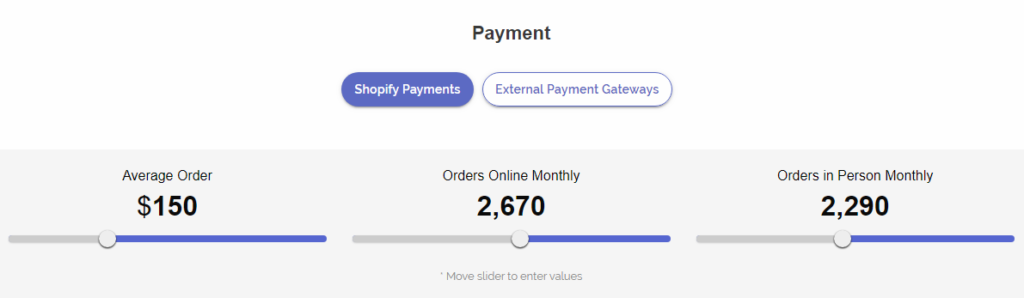
Shopify plan calculator is the most comprehensive calculator tool as of now to calculate the Shopify fees and costs for all plans. Indeed, selecting a Shopify plan requires careful consideration of the associated costs and fees. So, you’ll need to go through an arduous process of comparing features against prices.
Choose a Plan and Calculate the Fees and Charges
Let’s see first how you need to choose a plan and pay for it.
First of all, you need to choose a Shopify plan among several choices.
Secondly, you should choose a plan with your preferred features that more or less remain within your desired price bracket.
Lastly, choose a payment gateway.
Now, make the payment of fees for your desired plan.
The process of selecting a Shopify plan is easy. Let us mention the steps to use this Shopify plan calculator.
Add the particular Shopify plan fee
Now, add the transaction fees of the respective plan. (Transaction fee is charged as a percentage of sales)
Now add the estimated fee for the payment gateway
Thanks to this new calculator, calculating the monthly costs for a particular Shopify plan has become much easier. You can use the comparison table, which showcases different plan attributes and fees, to select a suitable plan.
After that, you can compare the payment gateways that match your store’s price point. Now add the fees listed above, and you will have the monthly cost for each plan, along with your selected payment gateway.
Calculating Transaction Fees Charged by Payment Gateway
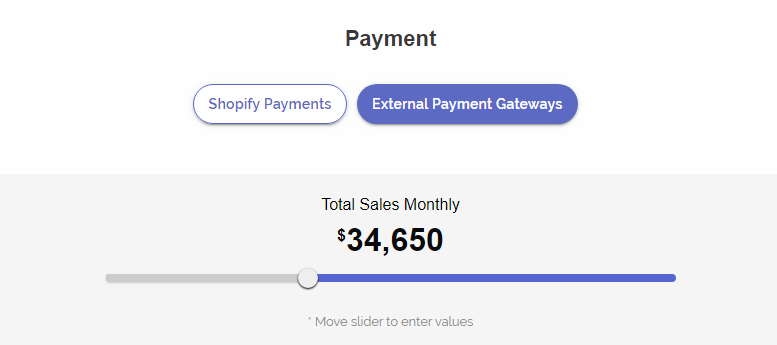
Regarding costs incurred through the payment gateway, please note that the calculator does not automatically include transaction fees for PayPal or WorldPay. This is because transaction fees vary by location and depend on sales volume.
Transaction fees for external payment gateways typically range from 1% to 4%, and you should estimate based on your location and expected sales volume.
To make things easier for you, Shopify offers an extensive list of supported payment gateways in every country. Crucially, this is one of the key variables that can affect the cost Shopify plans incur and influence the chosen payment gateways.
There is a significant opportunity to avoid transaction fees if you prefer to use your own payment gateway on the Shopify platform. Referred to as Shopify Payments, this gateway helps you eliminate the transaction fee on all transactions.
In contrast, you need to pay the applicable transaction fees for each third-party payment gateway. You can save 0.25%-2% on the transaction fee depending on your chosen Shopify plan.
Some external gateways can still help you reduce transaction fees and keep them to a minimum if you opt for top-tier Shopify plans, such as Shopify Plus or Shopify Advanced.
With these advanced or higher plans, you can access 3D Secure technology through an advanced payment gateway such as Opayo.
Why the Cheapest Plan Often Isn't
Basic costs $29 a month and charges 2.9% + 30¢ per online transaction if you don't use Shopify Payments, plus an extra 2% if you use a third-party gateway. Shopify at $79 a month drops that rate to 2.6% + 30¢, with only a 1% third-party penalty. Advanced at $299 a month goes further still, down to 2.4% + 30¢ and just 0.6%.
At low volume, Basic wins easily — the $50 a month you save on the subscription outweighs the fee difference. At higher volume, the fee gap stops being small. A store doing $15,000 a month in sales pays roughly $150 more in transaction fees on Basic than it would on the Shopify plan, which erases the subscription saving and then some.
Where the Real Crossover Sits
Most stores should move from Basic to the Shopify plan once monthly sales pass roughly $5,000. Below that, the lower subscription cost wins. Above it, the lower transaction rate wins, and the gap only grows as volume increases.
The move to Advanced or Shopify Plus follows the same logic at higher volume, where per-order savings on high transaction counts outweigh a bigger subscription fee.
The Variable Most Merchants Miss
Whether you use Shopify Payments changes the maths more than the plan itself does. Skip it in favour of PayPal or Stripe, and every plan adds a third-party fee on top of its base rate s much as 2% on Basic. On meaningful volume, that is often a higher cost than the difference between plans.
Shopify Payments also unlocks 3D Secure fraud protection on higher plans, which third-party gateways handle inconsistently.

Conclusion
Selecting a Shopify plan comes down to one number: your monthly sales volume. Below roughly $5,000 a month, the lower subscription fee wins. Above it, the lower transaction rate does. Run your own average order value and order count through the calculator above to see exactly where your store sits, or use our full Shopify Calculator for a complete monthly cost breakdown including apps and payment processing.
Recommended Reading:

Leave a Reply