Agentic AI in Healthcare: Enhancing Clinical Efficiency and Patient Outcomes
Introduction The Administrative Weight on Modern Healthcare Modern healthcare faces a paradox: as medical science advances, the people delivering care are increasingly b…
 Jun 15, 202611 min read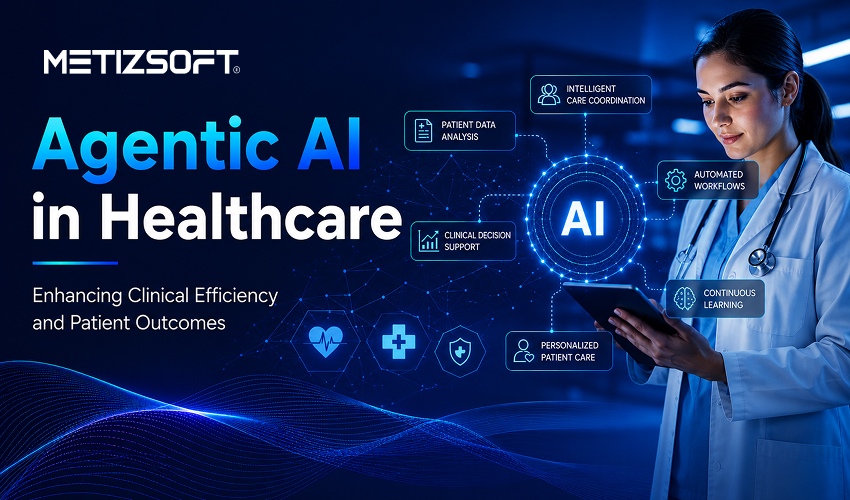
Introduction The Administrative Weight on Modern Healthcare
Modern healthcare faces a paradox: as medical science advances, the people delivering care are increasingly buried in non-clinical work. Studies consistently show that physicians spend a substantial portion of their day on documentation, administrative tasks, and electronic health record (EHR) data entr often as much time as they spend directly with patients.
This administrative burden has real consequences: clinician burnout, longer patient wait times, higher operational costs, and reduced capacity for the human interaction that defines good care. Hiring more staff helps, but the global shortage of healthcare workers makes that an incomplete solution.
This is where agentic AI enters not as a replacement for clinical expertise, but as a way to absorb the repetitive, time-consuming work that pulls medical staff away from patients. Unlike simple automation or chatbots, agentic AI systems can understand context, make decisions within defined boundaries, and complete complex multi-step workflows autonomously.
This guide examines how agentic AI in healthcare is being applied across clinical and operational settings with a clear-eyed view of both the opportunities and the responsibilities that come with deploying AI in a field where the stakes are measured in human wellbeing.
What Is Agentic AI in a Healthcare Context?
In healthcare, an agentic AI system is an autonomous AI that can perceive information, reason about it, and take action toward a defined goal within carefully governed boundaries. The distinction from traditional healthcare software matters:
Aspect | Traditional Healthcare Software | Agentic AI in Healthcare |
Function | Follows fixed rules | Reasons and adapts to context |
Documentation | Manual data entry | Generates notes from conversation |
Patient queries | Static FAQ responses | Natural, contextual conversation |
Workflows | Single, predefined steps | Multi-step, autonomous completion |
Role | A tool clinicians operate | An assistant that handles tasks |
An Important Principle
Throughout this guide, one principle holds: agentic AI in healthcare is designed to augment clinical teams, not replace clinical judgment. Diagnostic and treatment decisions remain firmly with qualified medical professionals. AI handles the workflows around those decisions freeing clinicians to focus on the decisions themselves.
Use Case 1: Automated Patient Intake and Scheduling
The patient journey often begins with friction: long hold times to book appointments, repetitive intake forms, and scheduling that does not account for clinical priority. Agentic AI streamlines this entire front-end experience.
What the agent does
Handles appointment booking through natural conversation, by phone or chat, 24/7
Collects patient intake information conversationally and structures it for the clinical team
Checks real-time availability and prioritises urgent cases appropriately
Sends automated reminders and pre-visit instructions to reduce no-shows
Manages rescheduling and cancellations, automatically filling freed slots from a waitlist
By automating intake and scheduling, clinics reduce front-desk workload, cut patient wait times, and capture appointments that would otherwise be lost to voicemail particularly valuable for after-hours enquiries when no staff are available to answer.
Use Case 2: Clinical Documentation and EHR Automation
Documentation is the single largest administrative burden in clinical practice. Agentic AI particularly systems built on advanced natural language processing can dramatically reduce the time clinicians spend on notes and records.
What the agent does
Listens to the patient-clinician conversation (with consent) and generates structured clinical notes
Populates EHR fields automatically, reducing manual data entry
Summarises patient history before a visit so the clinician walks in fully briefed
Generates referral letters, discharge summaries, and visit documentation in seconds
Flags missing information or potential coding gaps for clinician review
The impact here is direct and measurable: clinicians who adopt AI-assisted documentation often reclaim significant time per day time that goes back to patient care rather than typing. Crucially, the clinician always reviews and approves the final note, keeping a human in control of the medical record.
Use Case 3: Clinical Decision Support
This is the most sensitive application of agentic AI in healthcare, and the one where the augment-not-replace principle matters most. AI does not diagnose it surfaces relevant information to support the clinician's own judgment.
What the agent does
Retrieves relevant medical literature and guidelines matched to the specific clinical context
Surfaces potential drug interactions and allergy alerts from the patient's record
Highlights relevant patient history the clinician may want to consider
Provides evidence-based reference information at the point of care
Flags anomalies in lab results or vitals that warrant a closer look
Clear Boundary
Clinical decision support tools provide information and surface relevant data they do not make diagnoses or treatment decisions. Every clinical decision remains the responsibility of the qualified healthcare professional. The AI's role is to ensure the clinician has the right information readily available, not to replace their expertise.
Use Case 4: Remote Patient Monitoring and Proactive Care
Care does not end when a patient leaves the clinic. Agentic AI combined with connected devices enables continuous, proactive monitoring catching issues earlier and reducing avoidable readmissions.
What the agent does
Monitors data from wearables and home medical devices in real time
Detects concerning trends in vitals and flags them for clinical review
Conducts automated check-ins with patients managing chronic conditions
Sends medication reminders and tracks adherence
Escalates urgent situations to the care team with full context attached
For patients with chronic conditions diabetes, hypertension, heart conditions this kind of proactive monitoring can mean earlier intervention and fewer emergency situations. For health systems, it means better outcomes and lower costs from avoidable readmissions.
Use Case 5: Administrative and Revenue Cycle Automation
Behind every clinical interaction is a substantial administrative and billing operation. Agentic AI automates much of this back-office work, reducing errors and accelerating revenue cycles.
What the agent does
Automates medical coding and flags discrepancies before claims submission
Manages insurance verification and prior authorisation workflows
Processes claims and identifies likely denials before they happen
Handles billing enquiries from patients conversationally
Generates compliance and operational reports automatically
Revenue cycle inefficiencies cost healthcare organisations significantly through denied claims, coding errors, and administrative delays. Agentic AI reduces these losses while freeing administrative staff from repetitive processing work.
HIPAA, Compliance, and Patient Safety
No discussion of AI in healthcare is complete without addressing compliance and safety head-on. Healthcare data is among the most sensitive and heavily regulated in existence, and any agentic AI system must be built with this as a foundation, not an afterthought.
Essential requirements for healthcare AI
HIPAA compliance - all patient data handled within HIPAA-compliant infrastructure with encryption, access controls, and audit logging
Data privacy - strict adherence to GDPR and regional data protection regulations where applicable
Human oversight - clinical decisions always reviewed and approved by qualified professionals
Transparency - clear disclosure to patients when they are interacting with an AI system
Audit trails - complete logging of every AI action for accountability and review
Bias mitigation - careful testing to ensure the system performs equitably across patient populations
This is precisely why healthcare organisations should work with experienced AI development partners who understand both the technology and the regulatory landscape. Building compliant healthcare AI requires deep expertise in security, privacy, and clinical workflows - not just AI engineering.
The Technology Stack Behind Healthcare AI Agents
Building a production-grade, compliant healthcare AI agent requires several technologies working together within a secure architecture:
Layer | Purpose | Considerations |
Language Model (LLM) | Understands and reasons | Often deployed privately for data control |
NLP / Speech | Documentation, conversation | Medical vocabulary accuracy is critical |
Agentic Framework | Plans and executes workflows | Strict guardrails on actions |
EHR Integration | Connects to patient records | HL7 / FHIR standards compliance |
Secure Data Layer | Stores and protects data | HIPAA-compliant, encrypted |
Monitoring & Audit | Tracks every action | Full accountability and review |
The defining challenge in healthcare AI is balancing capability with compliance and safety. The technology must be powerful enough to genuinely reduce workload, yet governed tightly enough to meet the strict standards healthcare demands. This is where the integration of EHR systems via standards like HL7 and FHIR becomes essential.
Cost and Implementation Considerations
The investment for healthcare AI agents depends on scope, integration complexity, and compliance requirements. Here is a realistic overview:
Solution Scope | Build Cost | Timeline | Best For |
Patient intake / scheduling agent | $30K – $70K | 8-14 weeks | Clinics, practices |
Clinical documentation assistant | $50K – $120K | 12-20 weeks | Hospitals, clinics |
Remote monitoring platform | $80K – $180K | 16-24 weeks | Chronic care providers |
Full healthcare AI suite | $200K+ | 24-40 weeks | Health systems |
Compliance requirements add to both cost and timeline but they are non-negotiable in healthcare. Ongoing costs include secure infrastructure, LLM usage, and continuous monitoring. Most healthcare organisations begin with a single, well-defined use case typically scheduling or documentation to demonstrate value and build confidence before expanding.
Frequently Asked Questions
Will agentic AI replace doctors or nurses?
No. Agentic AI in healthcare is designed to handle administrative and repetitive tasks documentation, scheduling, monitoring, billing so that clinical staff can spend more time with patients. Diagnostic and treatment decisions remain entirely with qualified medical professionals. The goal is to reduce burnout and improve care capacity, not to replace the human expertise and judgment at the heart of medicine.
Is patient data safe with agentic AI systems?
It must be, and with proper implementation, it is. Compliant healthcare AI systems are built within HIPAA-compliant infrastructure with end-to-end encryption, strict access controls, and complete audit logging. Data privacy is the foundation of any healthcare AI deployment which is why working with developers experienced in healthcare compliance is essential.
How does agentic AI handle clinical decision-making?
It does not make clinical decisions. Clinical decision support tools surface relevant informatio guidelines, drug interactions, patient history, lab anomalies to support the clinician's judgment. The qualified healthcare professional always makes the actual diagnosis and treatment decision. The AI ensures they have the right information readily available at the point of care.
Can agentic AI integrate with our existing EHR system?
Yes. Healthcare AI agents integrate with major EHR systems through healthcare data standards like HL7 and FHIR. The AI works alongside your existing systems rather than replacing them reading from and writing to the EHR through secure, standards-compliant integrations.
How long does it take to deploy a healthcare AI solution?
A focused solution such as a patient scheduling agent can be deployed in 8-14 weeks. More complex solutions involving clinical documentation or EHR integration take 12-24 weeks, with additional time for compliance validation. Most healthcare organisations start with one use case and expand once value is demonstrated.
What makes healthcare AI different from AI in other industries?
Three things: regulation, sensitivity, and stakes. Healthcare data is heavily regulated (HIPAA, GDPR), intensely personal, and decisions can affect human wellbeing. This means healthcare AI requires far stricter compliance, more rigorous testing, stronger human oversight, and deeper domain expertise than AI in most other fields. It is not a domain for generic AI solutions.
Related Reading
For the foundational concepts behind autonomous AI systems, read our guide on From Copilot to Autonomous Agent: How Agentic AI Is Taking Over the Software Development Lifecycle. For how agentic AI transforms operations in other regulated industries, see Agentic AI in Embedded Finance: How Non-Financial Apps Are Building Lending, Cards, and Wallets. And for an example of autonomous AI in a high-stakes operational setting, read Agentic AI in Logistics: How Autonomous Agents Are Eliminating Delays and Manual Dispatch.
Ready to Build Your Healthcare AI Solution?
Metizsoft has 14+ years of experience delivering AI, ML, and software solutions including for the healthcare sector, where compliance and reliability are paramount. Our AI Agent Development team builds HIPAA-conscious healthcare AI agents from patient intake and clinical documentation to remote monitoring and revenue cycle automation with security and patient safety designed in from the start.
Whether you are a clinic looking to reduce front-desk workload or a health system planning a broader AI transformation, we can assess what is feasible and compliant for your specific needs, and outline a responsible deployment roadmap.
Book a free 30-minute consultation - metizsoft.com/contact
About Metizsoft
Metizsoft Solutions is a leading AI, ML, and software development company founded in 2012. With 400+ engineering specialists, 3,000+ projects delivered, and offices in India, the USA, the UK, and Singapore, we serve clients in 25+ countries. As an ISO-certified company, we specialise in Agentic AI, AI Development, Machine Learning, NLP Development, AI Agent Development, and healthcare AI solutions — building custom, compliant intelligent systems for healthcare, fintech, logistics, and commerce organisations worldwide.
Related reading: AI Agent Development | NLP Development | Agentic AI in Logistics | AI Development Services — metizsoft.com/ai-development-services
Leave a Reply